
What is the state of youth mental health & wellbeing today?
Surgo Health ran a comprehensive and equity focused study on youth mental health & wellbeing, revealing the current experiences of youth today. Our data draws on the direct voices of 4,500+ youth across the United States, surveyed in Spring 2024.
Thriving youth should be
the ultimate goal
Thriving means having both
good mental wellbeing and
good mental health.
Good Mental Wellbeing – Feeling content, socially connected, and having a sense of purpose and fulfillment
Good Mental Health – Having minimal poor mental health conditions such as depression, anxiety, and loneliness.
Mental
Wellbeing
Half of young
people are
doing well
Mental
Health
47%* haven't experienced significant mental health struggles over the past 2 years, reflected that they were satisfied with life and felt happy overall.
* 15-24 year olds since life satisfaction
was only asked to 15+
Mental
Wellbeing
Mental health challenges and wellbeing can
coexist
Mental
Health
Even amongst young people* who said that their mental health was not good, 50% were still optimistic about their future and felt that what they did in life was meaningful
* 15-24 for comparability
Even among young people without significant depression or anxiety symptoms, 22% reported dissatisfaction with life, a lack of optimism, or a sense of meaninglessness.
Thriving youth should be the ultimate goal
Thriving means having both
good mental wellbeing and
good mental health.
Good Mental Wellbeing – Feeling content, socially connected, and having a sense of purpose and fulfillment
Good Mental Health – Having minimal poor mental health conditions such as depression, anxiety, and loneliness.
47%* haven't experienced significant mental health struggles over the past 2 years, reflected that they were satisfied with life and felt happy overall.
* 15-24 year olds since life satisfaction
was only asked to 15+
Even amongst young people* who said that their mental health was not good, 50% were still optimistic about their future and felt that what they did in life was meaningful
* 15-24 for comparability
Even among young people without significant depression or anxiety symptoms, 22% reported dissatisfaction with life, a lack of optimism, or a sense of meaninglessness.
We are tracking and measuring a wide range of mental wellbeing and mental health outcomes to holistically capture youth experiences to help them thrive.
*Only asked ages 15-24
Reading this graph
The inner ring represents 0%, and the outer ring represents 100% of mental well-being and mental health.
We are tracking and measuring a wide range of mental wellbeing and mental health outcomes to holistically capture youth experiences to help them thrive
Key Takeaway
While it is true that a significant amount of young people are struggling with their mental health, a large proportion are also reflecting good mental wellbeing overall in their life.
Reading this graph
The inner ring represents 0%, and the outer ring represents 100% of mental well-being and mental health.
-
Mental Wellbeing
Life Satisfaction: Reporting very satisfied or satisfied to the question “Overall, how satisfied or dissatisfied are you with your life?”
Happiness: Reporting slightly or extremely happy to the question “Overall, how happy or unhappy would you say you are?”
Meaning in Life: Slightly or strongly agree with the statement “Overall, I feel that what I do in my life is meaningful”
Optimism: Slightly or strongly agree with the statement “I am optimistic about my future”
Positivity: Slightly or strongly agree with the statement “I usually feel very positive about myself”
Social wellbeing: Slightly or strongly agree with the statement “I feel like I can do things to help others, such as in my family or with my friends, volunteering in my community, or giving to charity.”
Quick to recover and return to normal when things go wrong: Slightly or strongly agree with the statement “When things go wrong in my life I usually get back to normal quickly.”
Not hard to let go of bad feelings: Slightly or strongly disagree with the statement “I find it hard to let go of bad feelings”
Not hard to express myself to others: Slightly or strongly disagree with the statement “I find it hard to express myself to others”
Mental Health
Poor mental health: Reporting most of the time or always to the question “During the past 30 days, how often was your mental health not good? (Poor mental health includes stress, anxiety, and depression.)”
Depressive symptoms: Based on PHQ2 which inquires about the frequency of depressed mood and anhedonia over the past two weeks.
Anxiety symptoms: Based on GAD2 which inquires about the frequency of nervousness, anxiety or worrying over the past two weeks.
Self-harmed: Ever engaged in or considered self-harm without suicidal intent
Loneliness: Felt lonely more than half of the days over the past two weeks
Mental health struggles: In the past two years, experienced mental health struggles so much that it made day-to-day activities a lot harder
Mental health diagnosis: Ever been diagnosed with a specific mental health problem by a mental health professional
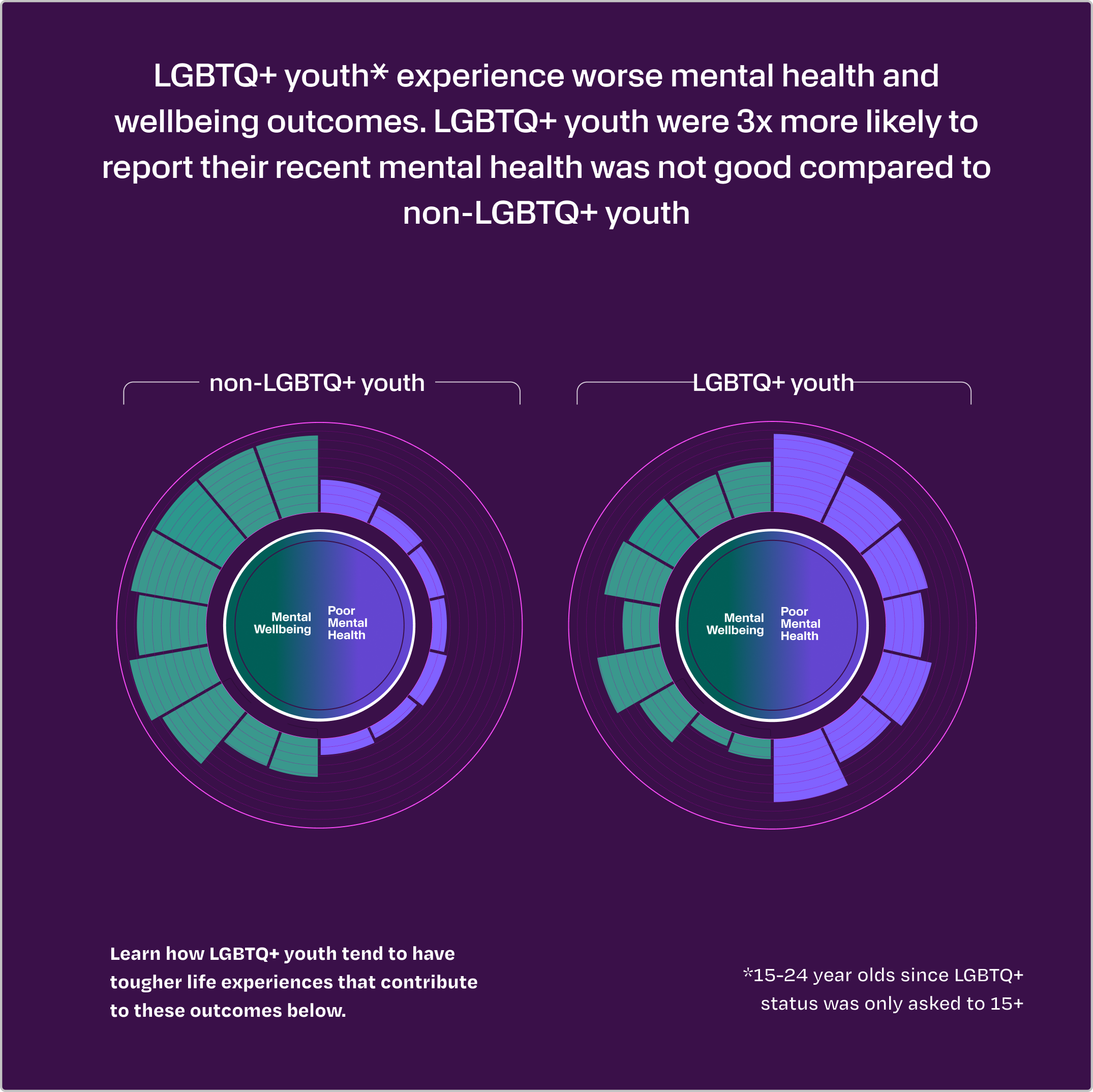
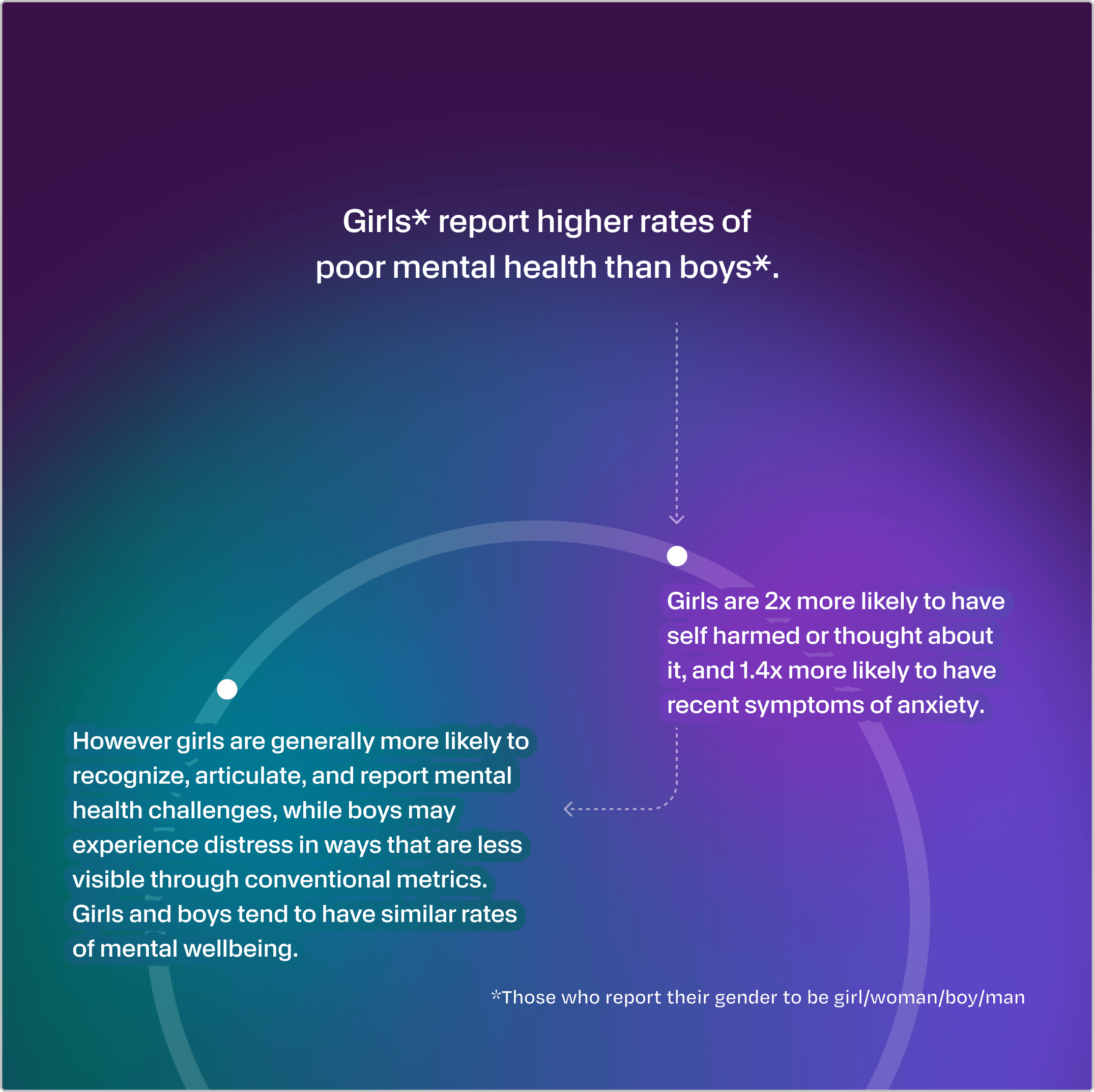
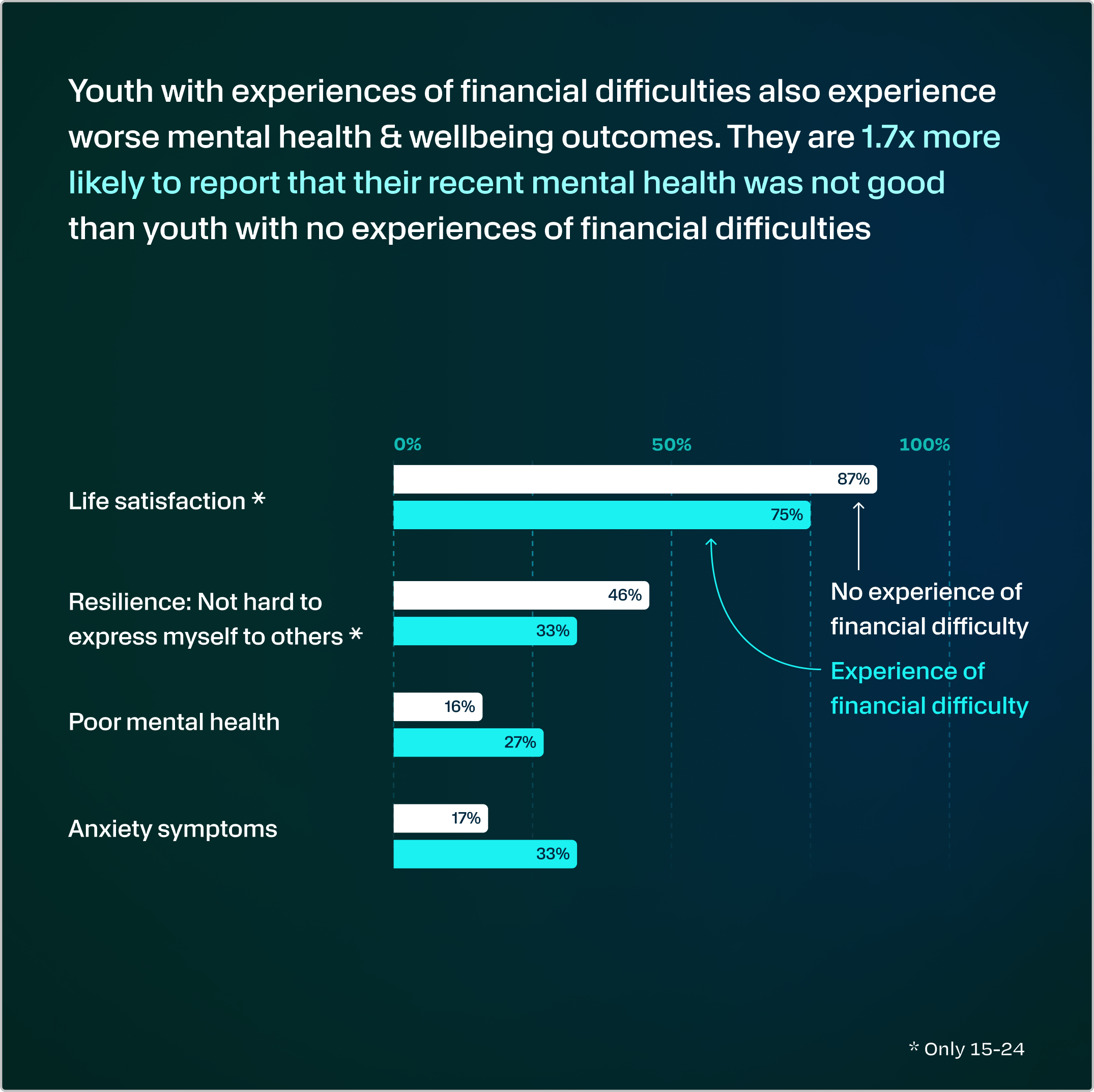
What does mental health and wellbeing look like for intersectional identities?
Young people can have multiple identities and lived experiences that interact to impact mental health and wellbeing. Explore mental health and wellbeing outcomes for intersectional identities
Hear the Stories
A deeper dive—What’s associated with youth mental health and wellbeing?
We asked 50 questions pertaining to 12 protective and risk factors known to impact mental health and wellbeing in young people, as supported by existing literature. Our data shows 6 factors as the most closely linked to mental health and wellbeing.
Social Support
The availability of emotional support from family, friends, and close relationships.
Sense of Belonging
The feeling of acceptance and connection within a group, such as friends, family, school, or community, fostering a sense of inclusion.
Physical Health
The overall state of an individual’s physical wellbeing, reflecting how they perceive and experience their physical health.
Stress
The experience of overwhelming pressure or challenges that feel difficult to manage.
Only asked to 15-24 year olds
Negative Life
Experiences
Exposure to difficult or traumatic situations in life, such as violence, neglect, or family challenges.
Only asked to 15-24 year olds.
Social Media
The complex experience of social media on self-perception, relationships, and emotions, encompassing both positive connections and negative influences.
Hear the Stories
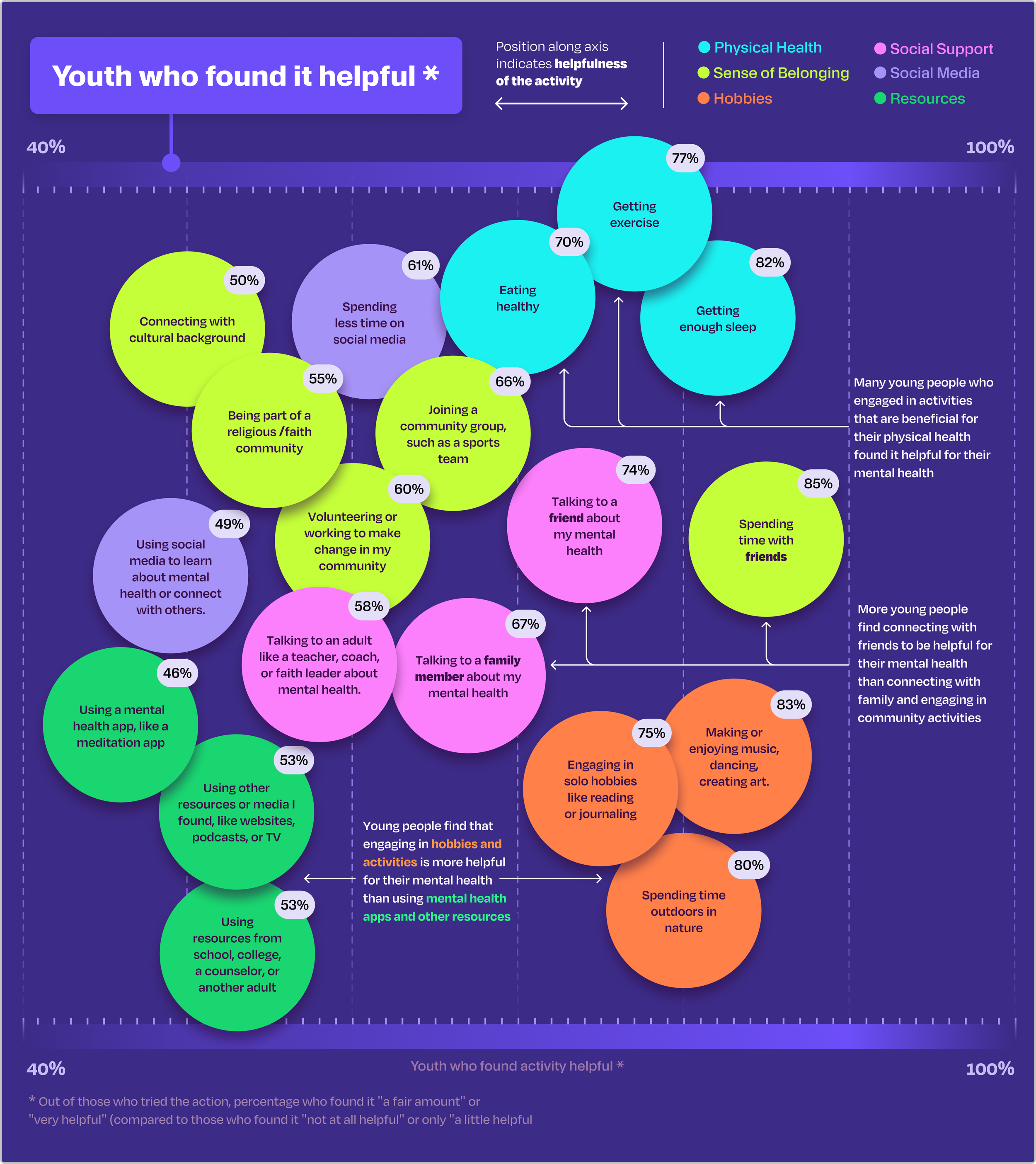
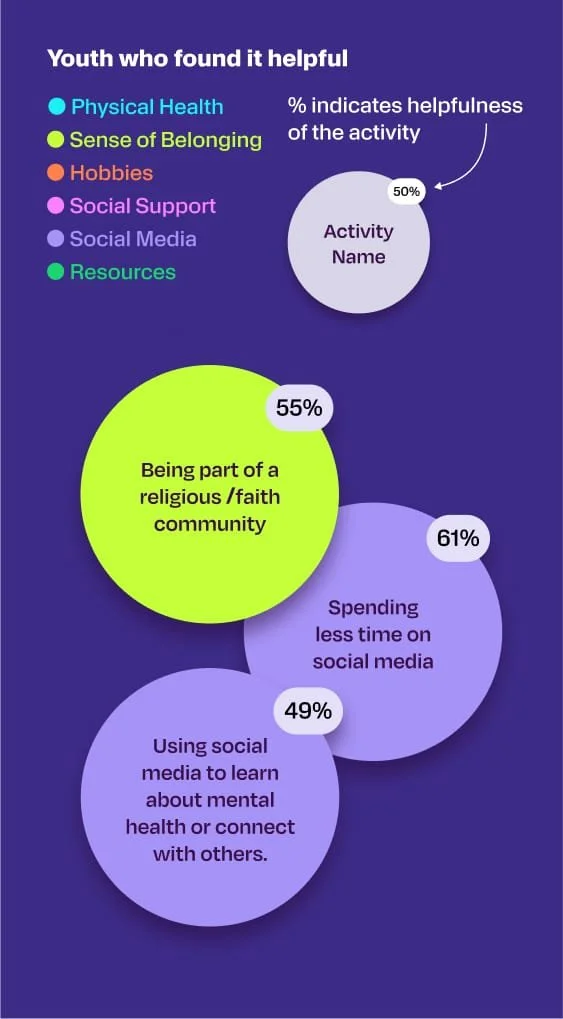
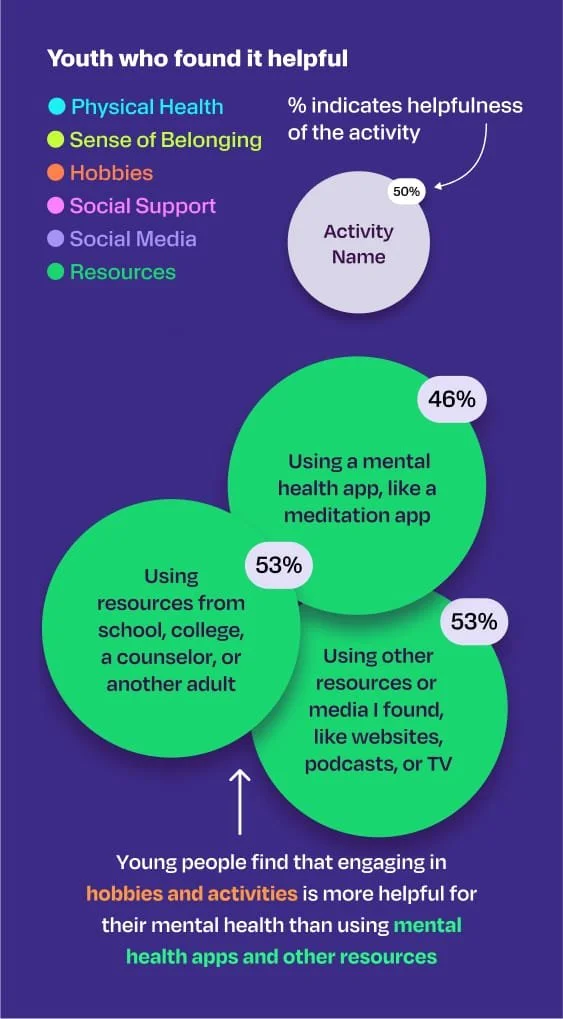
What do youth consider helpful for their mental health & wellbeing?
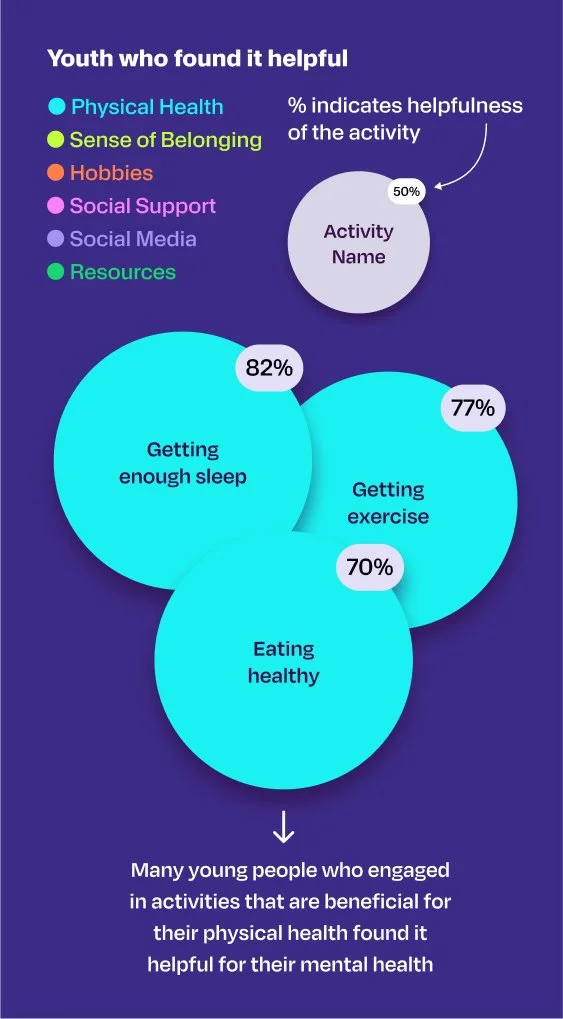
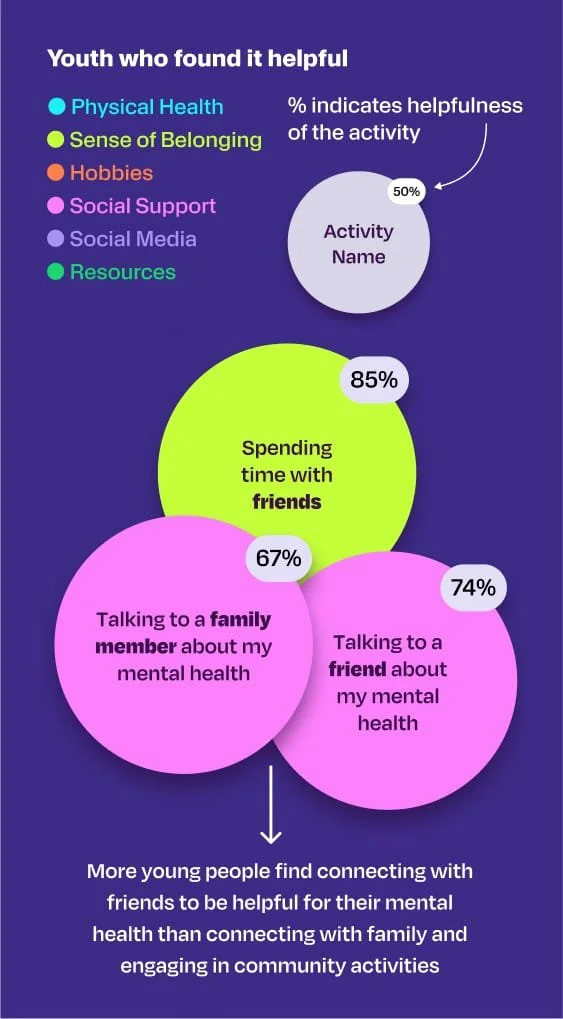
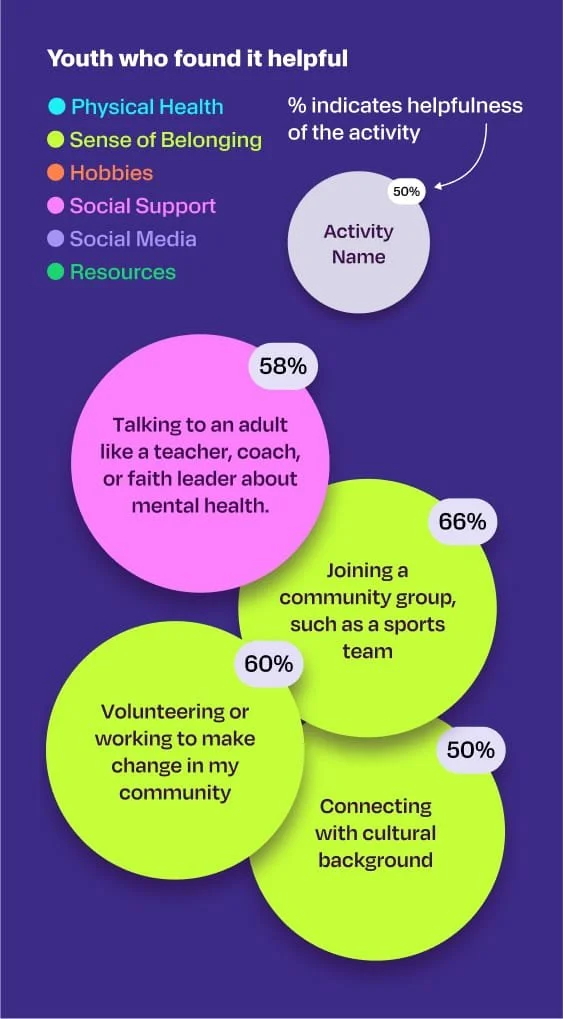
Our data shows that the activities youth find helpful for their mental health & wellbeing are closely associated the themes linked to mental health & wellbeing outcomes
| Activity | Helpfulness (%) | Category | Additional Notes |
|---|---|---|---|
| Getting enough sleep | 82% | Physical Health | N/A |
| Getting exercise | 77% | Physical Health | N/A |
| Eating healthy | 70% | Physical Health | N/A |
| Spending time with friends | 85% | Social Support | More young people find connecting with friends to be helpful for their mental health than connecting with family or community activities. |
| Talking to a friend about my mental health | 74% | Social Support | N/A |
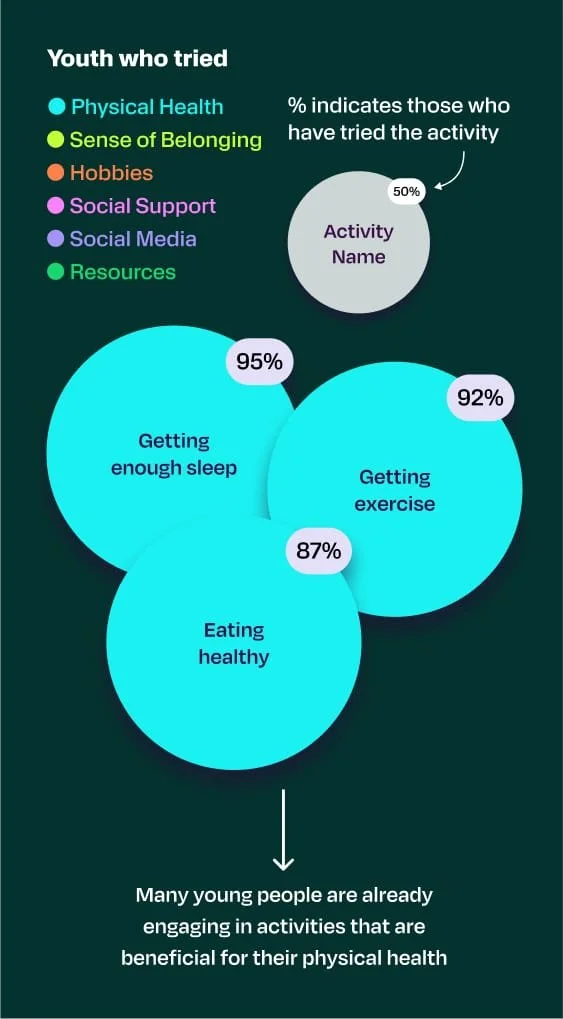
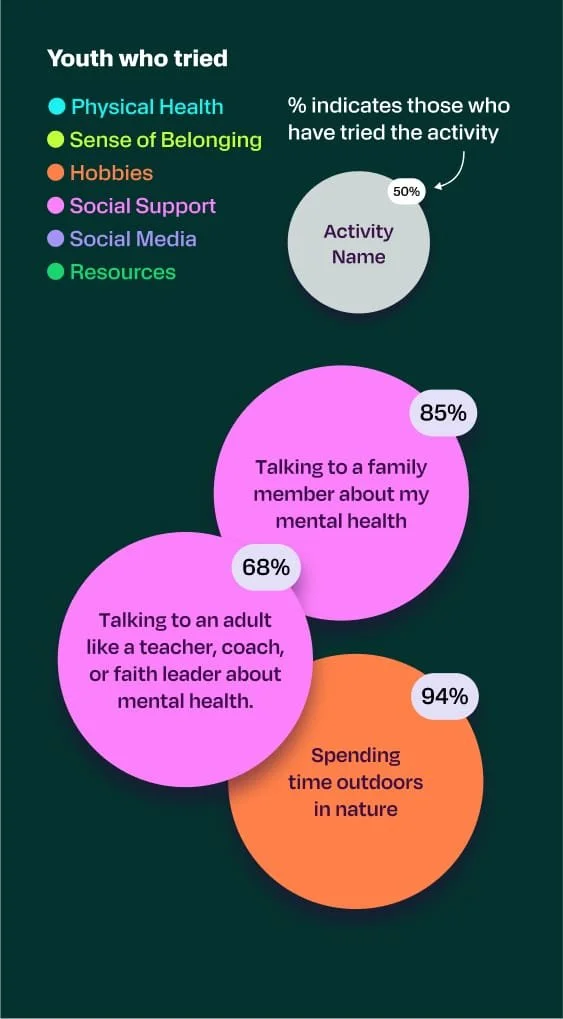
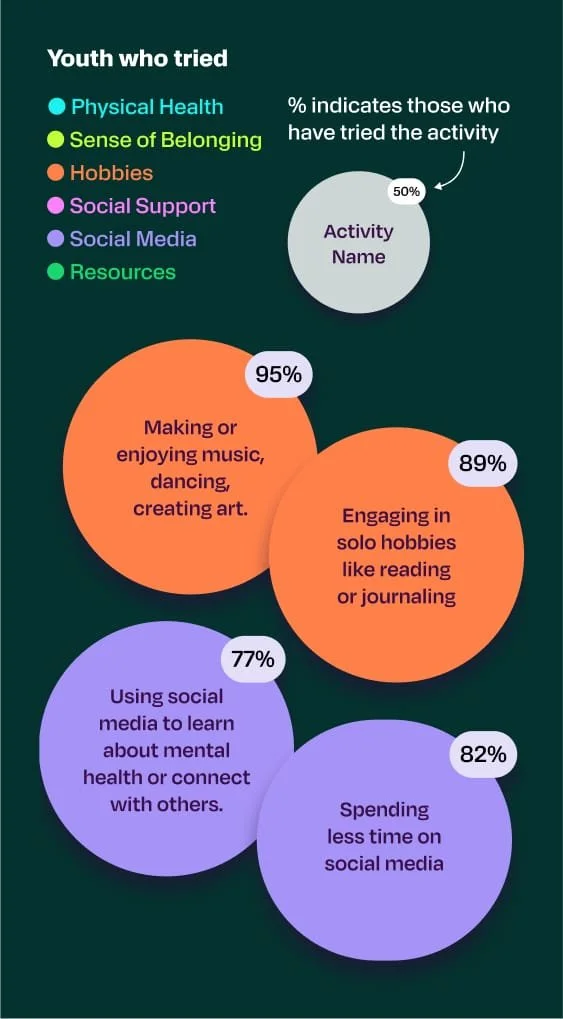
| Activity | Percentage of Youth Who Tried | Category | Additional Notes |
|---|---|---|---|
| Getting enough sleep | 95% | Physical Health | Many young people are already engaging in activities beneficial for their physical health. |
| Getting exercise | 92% | Physical Health | Many young people are already engaging in activities beneficial for their physical health. |
| Eating healthy | 87% | Physical Health | Many young people are already engaging in activities beneficial for their physical health. |
| Spending time with friends | 96% | Social Support | Many young people are already engaging in activities to connect with others. |
| Talking to a friend about my mental health | 85% | Social Support | |
| Talking to a family member about my mental health | 82% | Social Support | |
| Spending less time on social media | 82% | Social Media | |
| Making or enjoying music, dancing, creating art | 95% | Hobbies | |
| Spending time outdoors in nature | 94% | Hobbies | |
| Engaging in solo hobbies like reading or journaling | 89% | Hobbies | |
| Being part of a religious/faith community | 73% | Sense of Belonging | |
| Using social media to learn about mental health or connect with others | 77% | Social Media | |
| Joining a community group, such as a sports team | 72% | Sense of Belonging | |
| Using other resources or media I found, like websites, podcasts, or TV | 71% | Resources | |
| Talking to an adult like a teacher, coach, or faith leader about mental health | 68% | Social Support | |
| Using resources from school, college, a counselor, or another adult | 66% | Resources | |
| Volunteering or working to make change in my community | 67% | Sense of Belonging | |
| Connecting with cultural background | 64% | Sense of Belonging | |
| Using a mental health app, like a meditation app | 54% | Resources | Fewer young people use mental health apps and other resources, which have mixed effects on those who do use them. |





Social media can have both positive & negative impacts on mental health & wellbeing
Our data shows that many young people do see negative things on social media that make them feel bad about themselves and the world. However, social media is also often used in positive ways that support hobbies and interests, enable social connections and allow for the exploration of identities.
Social media helps me learn about issues in the world sometimes or all the time
Social media is important for me to give and get emotional support to and from others
54% of youth with experiences of financial difficulties believe that social media is important to give and receive emotional support.
Social media is important for me in my hobbies or interests
79% of Asian youth say that social media is important for their hobbies and interests.
Social media is important for me to connect with my friends
3 in 4 young people reported that social media is important for them to connect with their friends.
Social media is important for me to explore my identity
72% of LGBTQ+ youth say that social media is important for them to explore their identity
I have tried to reduce the amount of time I spend on digital devices
I use digital devices like mobile phones, laptops and gaming devices almost constantly every day
91% of LGBTQ+ youth report being on digital devices almost constantly every day
I see things on social media that make me feel bad about my appearance or body sometimes or all the time
Fewer (36%) Black youth see things on social media that make them feel bad about their appearance or body
I see things on social media that make me feel like I am not as good as other people sometimes or all the time
I see things on social media that make me feel unhappy about the world sometimes or all the time
84% of multiracial youth report seeing things on social media that make them feel unhappy about the world
Explore the Data On Your Own
See how populations are experiencing mental health and wellbeing outcomes by selecting from the dropdowns below